
On this page
For a visual overview of the company milestones — from founding to today in six icons — see the Our History page. This article is a deeper, methodological and regulatory deep-dive for occupational hygienists who want to understand how the DOHSBase hierarchy evolved technically and under regulation.
Summary: DOHSBase started on 13 February 1992 as an initiative of the Dutch Occupational Hygiene Society (NVvA), with 1,000+ occupational exposure limits and measurement methods delivered on a 3.5" or 5.25" MS-DOS diskette. From there it evolved through the 2006 NVvA Newsletter article on the Compare mode (TOX, TIX and RAS indices), the Scheffers & Wieling 2005 article on kick-off values, and the 2007 SER decision scheme — which SER took offline again in 2020 — to today’s online database of 325,000+ substances. The underlying methodology — hierarchically ordering limit values by reliability and independence from stakeholder interests — has remained consistent across all those decades. This article traces the historical arc from the first diskette to the present.
The Origin: DOHS-Base 1992
On 13 February 1992, the first copy of DOHS-Base — then still spelled with a space and a hyphen — was handed personally by NVvA chairman Mr. Boers to Ms. Mulock Houwer, Director-General for Labour at the Dutch Ministry of Social Affairs. The handover took place in the context of the new European Framework Directive on safety and health at work (Directive 89/391/EEC), which for the first time gave employers an explicit duty to assess workplace risks — and therefore created an acute need for an accessible, structured source of limit values and measurement methods.
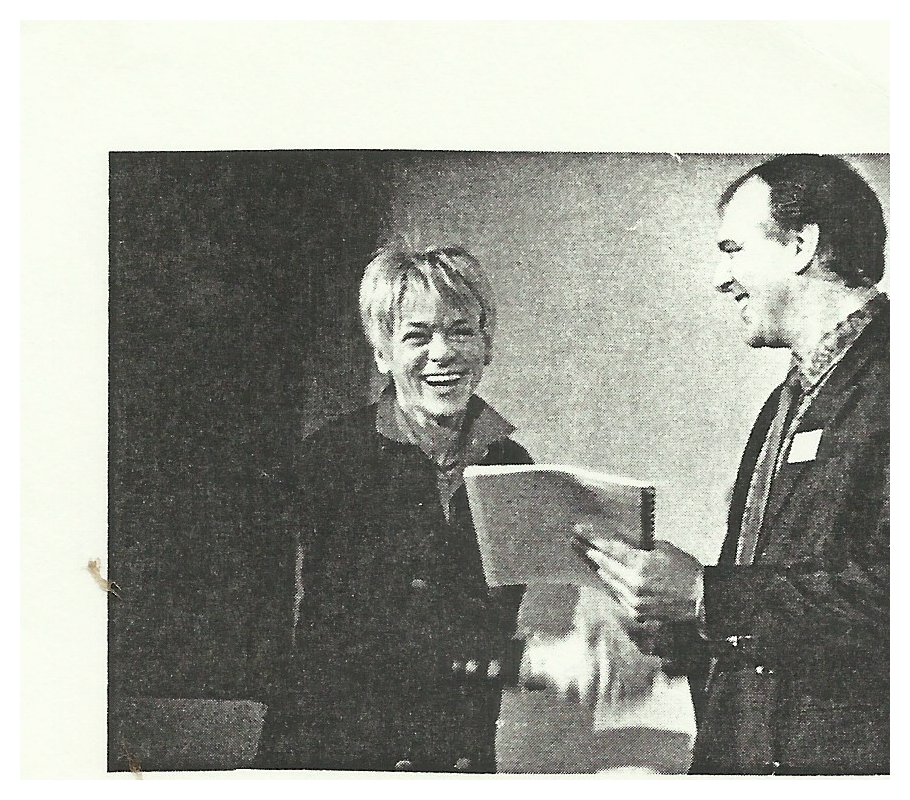
Source: Normalisatie Magazine, March 1992. Photo reproduced from the contemporaneous NVvA brochure that credits the original article in Normalisatie Magazine.
Mulock Houwer was quoted in a statement that confirmed the project’s relevance: “The realisation of DOHS-Base is an initiative that fits excellently within the occupational health and safety policy the government is shaping, partly in response to the new EEC Framework Directive on safety and health at work.” On her suggestion, the NVvA decided soon after launch to periodically update and adapt DOHS-Base to developments in national and European legislation — setting the release pattern for every subsequent version.
What the first release contained
The 1992 NVvA brochure explicitly describes the scope of the initial release:
- 1,000+ occupational exposure limits and measurement methods for chemical and biological agents (for comparison: DOHSBase Online today holds over 325,000 substances).
- Alongside the Dutch MAC values, the first release also included health-based advisory limits from the Werkgroep van Deskundigen and biological limit values — the forerunners of what today forms the lower tiers of the hierarchy (Health Council advisory values and biological limits).
- Measurement methods were initially drawn from the pre-standards (voornormen) of the Dutch Standards Institute (NEN) — which explains why Normalisatie Magazine covered the project with an article at the time.
- Three search modes: by name (Dutch, synonym, English), by CAS number, and by EINECS number. This three-way search setup is still one of the core features of DOHSBase Online — 34 years later, still advertised on the product page as “search 325,000+ chemical substances by CAS number, EC number or substance name”.
The technology of 1992
DOHSBase 1.0 shipped on a 3.5" microdiskette (720 KB) or 5.25" diskette (360 KB) and ran on an IBM XT or AT — or compatible — under MS-DOS 2.3 to 2.11 or DR-DOS 6.0. The manual and the database together fit on a single diskette. The price was Hfl. 100,- (roughly €45 in face value, without inflation adjustment). The system worked on every monitor type then available — CGA, EGA or VGA.
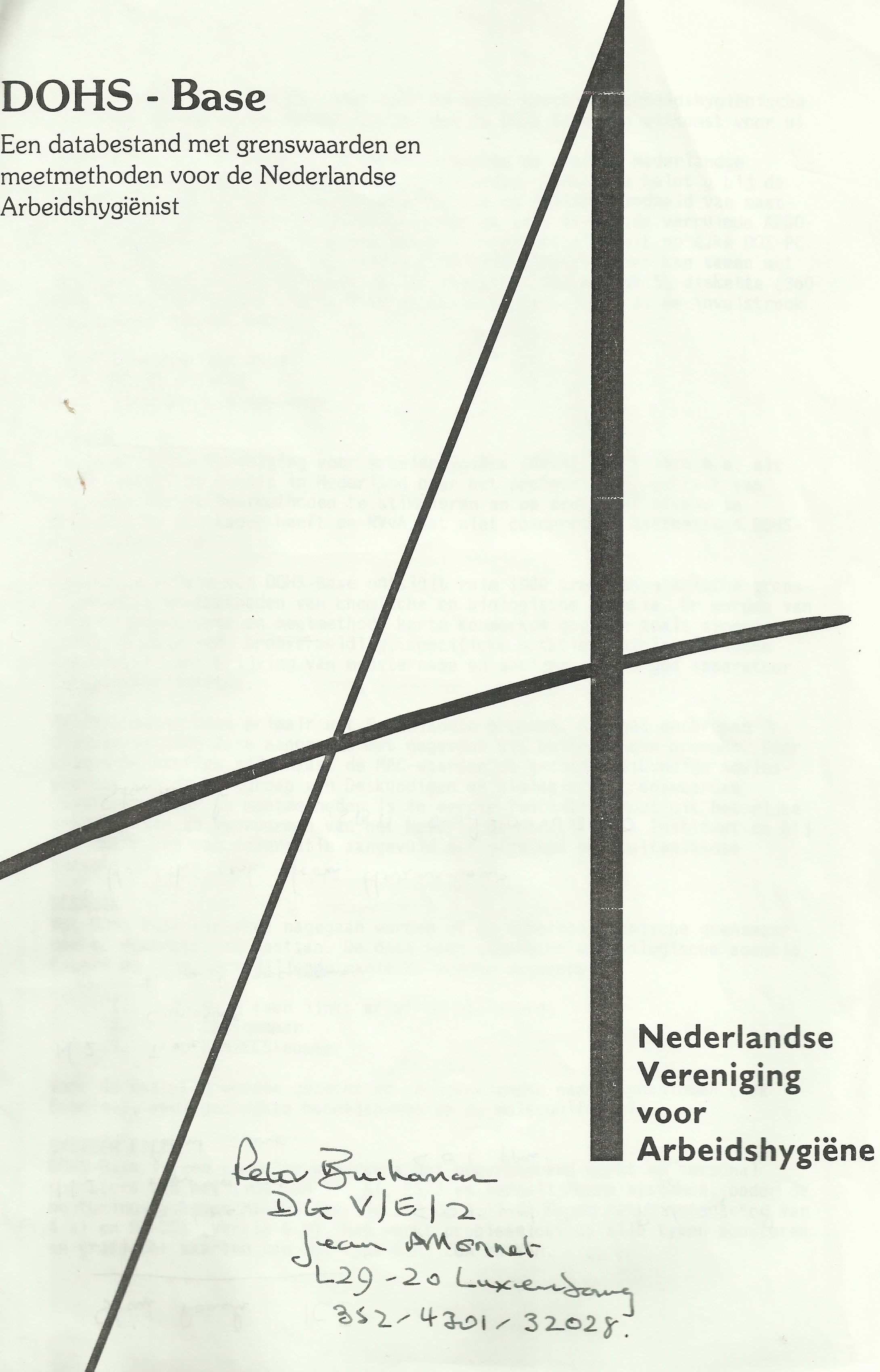
Front cover of the 1992 NVvA DOHS-Base brochure. The handwritten address on this particular archive copy — Peter Buchanan, DG V/E/2, Jean Monnet, L-2920 Luxembourg — shows that DOHS-Base was being sent to the European Commission within its first year. DG V at the time was the Directorate-General for Employment and Social Affairs: the originator of the Framework Directive that Mulock Houwer linked the project to.
The etymology of “DOHS”
The acronym DOHS stands for Dutch Occupational Health and Safety — as the founders have since explained the name. The 1992 brochure itself does not spell the acronym out; its cover uses only the form “DOHS - Base” (space + hyphen) and the Dutch subtitle “A database of limit values and measurement methods for the Dutch occupational hygienist”. The contracted modern spelling “DOHSBase” gradually became the norm in the following years.
1995: Spin-off into DOHSBase v.o.f.
In 1995 the NVvA concluded that maintaining and developing DOHS-Base was not a core activity of the society, and that the database would be better served by being given its own chance to stand on its own feet. DOHS-Base therefore spun off as DOHSBase v.o.f. (vennootschap onder firma, the Dutch general-partnership legal form between natural persons). From that moment onward, the database was run as a business, with the ability to release periodic updates outside the NVvA structure, sign commercial contracts, and develop the product on the cadence of a commercial offering rather than a volunteer project. The NVvA stayed involved through symposia, publications and personal memberships — the tie with the society was never cut, only reshaped.
The Prequel: 2005–2006
DOHSBase was set up in the early 2000s to address a concrete problem Dutch occupational hygienists ran into every day: most substances present in a workplace do not have a formal statutory limit value, and where multiple values exist, they differ from source to source. The only workable response was a principled method for making a consistent choice — a hierarchy that ordered sources by reliability, independence from stakeholder interests, and applicability under Dutch occupational health legislation.
The first public appearance of this methodology was the article “Kick-off grenswaarden voor stoffen zonder grenswaarden” (Scheffers & Wieling, 2005, Tijdschrift voor toegepaste Arbowetenschap no. 3). A year later, NVvA Newsletter 2006-01 carried an in-depth article by DOHSBase introducing the Compare (“Vergelijk”) mode of DOHSBase2000, together with the supporting indices underneath it: the TOX index (hazard classification from R-phrases, with selectable schemes such as COSHH, TRGS and EMKG), the TIX index (threshold exceedance index — the ratio between the saturation concentration and the limit value), and the RAS score (risk assessment score — the product TOX × TIX). This combination — hazard × inhalation potential — has been the core of DOHSBase Compare ever since and is still in use in 2026.
The hierarchical ordering of limit-value sources that SER adopted a year later built directly on this 2005–2006 foundation. The 2006 article is therefore the earliest public record of what is today known as the “DOHSBase methodology”.
The SER 2007 Decision Scheme
In 2007, DOHSBase shared this hierarchy with the Dutch Social and Economic Council (SER) free of charge. SER incorporated the hierarchy into the official decision scheme for chemical substance limit values and published the scheme on the national information portal veiligwerkenmetchemischestoffen.nl, targeting employers and occupational hygienists. The scheme itself looks like this:
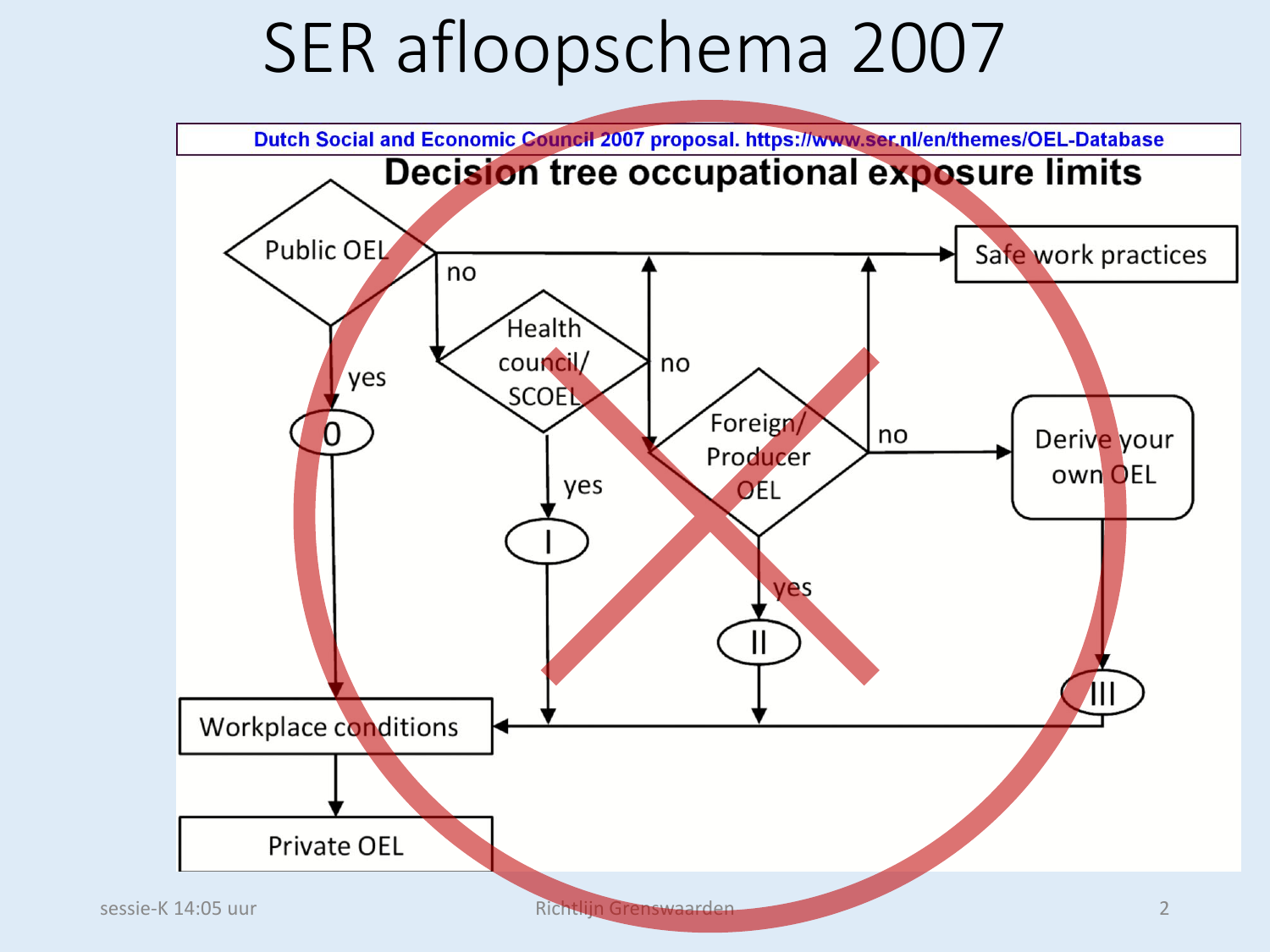
Source: Theo Scheffers, “(NVvA/SER) Richtlijn Grenswaarden”, session K, NVvA Symposium 9 April 2025 (p.2). The decision scheme itself is an adapted version of the original DOHSBase proposal from 2007.
The red X in the image is deliberate. It marks 2020 — the year SER removed the entire veiligwerkenmetchemischestoffen.nl site, including this scheme, from the internet on the grounds that it was “hardly being used.” The scheme has not been publicly available since, and is not recoverable from the Internet Archive Wayback Machine either — it only survives in presentations such as Theo’s at the 2025 NVvA Symposium.
What Changed in the Meantime
The international OEL landscape was already complex in 2007 and has only become denser since. The key developments:
- REACH DNELs (from 2008). Under REACH, manufacturers must derive Derived No-Effect Levels for product safety in the commercial chain. A DNEL is not a workplace limit, but in practice it is often used as a fallback when no OEL exists. DOHSBase currently holds 5,300+ DNELs for around 4,800 substances.
- Hazard banding and kick-off values. For the 90,000+ substances without any formal OEL, H-statement-based hazard banding provides a fast, defensible floor. See our background article on kick-off values for the methodology.
- Disappearing sources. Beyond the SER scheme, a number of other public sources have become harder to find or have disappeared outright. That makes the need for a consolidated, maintained database larger, not smaller.
- More stakeholder influence on public values. Several national committees now work with explicit stakeholder participation. For the hierarchy this means: “public health-based value” is no longer, by definition, unbiased. The current DOHSBase hierarchy therefore splits Tier 1 (unbiased health-based, e.g. RAC, SCOEL, DECOS, ACGIH-TLV) explicitly from Tier 2 (health-based but with stakeholder influence, e.g. AGS, NIOSH REL, EU IOEL).
The 2007 Hierarchy Today
The logic of the SER 2007 decision scheme — decide in a fixed order, stop at the highest available tier, and only derive a limit when nothing else is available — is still the foundation of how DOHSBase presents limit values. See the overview article on the limit-value hierarchy for the current six tiers, and the webinar on the hierarchy for a more detailed walkthrough.
The kick-off value in the European standard
In 2018 the methodology turned up somewhere DOHSBase had not put it. EN 689:2018 — adopted in the Netherlands as NEN-EN 689:2018+C1:2019 — sets out in Annex B which limit values you use to test a workplace assessment against. The text of that annex gives the kick-off value as an example of an in-house derived limit value, without attribution. The term comes from Scheffers & Wieling (2005), described above.
The same annex names DOHSBase in its list of sources for limit values, alongside SCOEL, GESTIS, the DFG list and the SER database — the only private database in that list.
What began in 2005 as a proposal in a Dutch trade journal has therefore entered the European standard in two ways: as a term in the running text, and as a source in the list. One qualification belongs with that: Annex B is informative, not normative. The standard offers both as examples; it does not prescribe them.
Sources
- CEN (2018). EN 689:2018+AC:2019 — Workplace exposure. Measurement of exposure by inhalation to chemical agents. Strategy for testing compliance with occupational exposure limit values. Adopted in the Netherlands as NEN-EN 689:2018+C1:2019.
- Dutch Occupational Hygiene Society (NVvA) (1992). DOHS-Base — A database of limit values and measurement methods for the Dutch occupational hygienist. NVvA brochure, February 1992, incorporating text and a photo from Normalisatie Magazine (Dutch). Local copy
- DOHSBase (2006). DOHSBase — Comparing substances with TOX, TIX and RAS. NVvA Newsletter 2006-01, April 2006 (Dutch). Local copy
- Scheffers, T. & Wieling, G. (2005). “Kick-off” grenswaarden voor stoffen zonder grenswaarden. Tijdschrift voor toegepaste Arbowetenschap, no. 3, 67–75.
- Scheffers, T. (2025). (NVvA/SER) Richtlijn Grenswaarden — Hulp bij het vinden èn afleiden van private waarden. Session K, NVvA Symposium 9 April 2025. PDF at arbeidshygiene.nl · local copy
- Scheffers, T., Doornaert, B., Berne, N., van Breukelen, G., Leplay, A., & van Miert, E. (2016). On the Strength and Validity of Hazard Banding. Annals of Occupational Hygiene, 60(9), 1049–1061. ResearchGate
- Dutch Social and Economic Council. Former website veiligwerkenmetchemischestoffen.nl (offline since 2020, no Wayback snapshot available).
For an overview of external publications that cite or use DOHSBase, see DOHSBase in the literature.