
On this page
Key Summary: Kick-off values are conservative exposure benchmarks developed by DOHSBase (since 2005) for substances that lack formal occupational exposure limits. They are calculated as the 10th percentile lower bound of the OEL distribution within the highest hazard class assigned to a substance based on its H-statements, meaning 90% of existing OELs for similar substances are higher. Over 100,000 kick-off values are available in DOHSBase, bridging the gap for tens of thousands of substances without formal limits. The methodology uses Control Banding principles and GHS/CLP hazard classification. The Dutch Labour Inspectorate has recognized kick-off values as an acceptable approach for compliance since 2012.
The kick-off methodology is, in direct terms, an NVvA methodology: developed within the NVvA Working Group on Limit Values and Measurement Methods (out of which DOHSBase was founded in 1992), first published through the NVvA Newsletter (Wieling & Scheffers, 2006-01), and peer-reviewed by Theo Scheffers (Honorary Member of the NVvA) in On the Strength and Validity of Hazard Banding (Annals of Work Exposures and Health, 2016). When trade literature or regulatory documents refer to the “NVvA methodology” for substances without formal occupational exposure limits, they are describing this kick-off methodology.
Understanding Kick-off Values
In occupational hygiene, establishing safe exposure limits for hazardous substances is crucial. However, not all substances have formal occupational exposure limits (OELs). To address this gap, DOHSBase introduced the concept of “kick-off values” in 2005. These values serve as conservative starting points for risk assessment when formal OELs are absent.
Naming: in the literature and in search traffic this term appears in several spelling variants — kick-off values, kickoff values, kick off values or kickoffvalues, with or without hyphen or space. DOHSBase consistently uses the hyphenated form (“kick-off values”). All variants refer to the same methodology described in this article.
A kick-off value represents the 10th percentile lower bound of the distribution of existing OELs within the highest hazard class assigned to a substance based on its most severe hazard statements (H-statements). This means that 90% of the OELs for substances in the same hazard category are higher than the kick-off value, making it a cautious estimate.
If implementing the kick-off value is technically and economically feasible, it may eliminate the need for extensive procedures to establish a health-based company-specific OEL. However, if the kick-off value is not feasible, a more precise health-based OEL can still be determined through detailed studies, including animal experiments or epidemiological research, incorporating appropriate safety factors.
The use of kick-off values in the absence of formal OELs has been accepted by the Nederlandse Arbeidsinspectie (formerly Inspectie SZW) since 2012 when monitoring compliance with hazardous substances regulations. The DOHSBase methodology is listed as one of the recognised sources for finding a limit value in the Arbeidsinspectie’s self-inspection tool for hazardous substances, alongside SER, Gestis and COSHH. The Arbeidsinspectie’s December 2023 guidance document Hoe ga ik te werk bij het vaststellen van grenswaarden? and the RIVM knowledge note Totstandkoming grenswaarden voor stoffen op de werkplek in Nederland (KU-2023-0008, July 2023, commissioned by the Dutch Ministry of Social Affairs) place kick-off values at step 6 of the hierarchy of sources for private limit values.
The Need for Kick-off Values
The challenge that kick-off values address is fundamentally one of scale. There are hundreds of thousands of chemical substances in commercial use, but the process of establishing a health-based OEL is slow, expensive, and data-intensive. A single OEL derivation by a national or European scientific committee can take years and requires a comprehensive toxicological dossier. As a result, only a small fraction of substances in use have formal OELs – typically around 500 to 800 per country, depending on the jurisdiction.
Meanwhile, employers are legally required to assess the risks of all hazardous substances their workers may be exposed to. Without a quantitative benchmark, this assessment becomes subjective and inconsistent. The kick-off value methodology was developed to bridge this gap in a scientifically defensible way, providing a quantitative reference point for the tens of thousands of substances that lack formal limits.
Calculation of Kick-off Values
Control Banding Systems
The kick-off values are based on the limit value distribution of substances in groups of H-statements with similar effects. In the 1990s, so-called “Control Banding” systems were developed as a tool for employers to determine exposure-reducing measures. Substances with similar effects (the same H-statements or previously: R-statements) are grouped into hazard categories.
Control Banding is a pragmatic approach to chemical risk management that emerged from the recognition that detailed quantitative risk assessments are not feasible for every substance in every workplace. The core principle is straightforward: substances that cause similar types of harm should be managed with similar levels of control. By grouping substances into bands based on their hazard classifications, Control Banding provides a structured framework for selecting appropriate control measures – from general ventilation for low-hazard substances to full containment for highly toxic ones.
The most widely known Control Banding systems include the COSHH Essentials model developed by the UK Health and Safety Executive, the Stoffenmanager system from the Netherlands, and the ILO Chemical Control Toolkit. Each of these systems groups substances into hazard bands using classification criteria that are closely aligned with GHS/CLP H-statements.
DOHSBase builds on this foundation by using the same hazard groupings not just to recommend control measures, but to derive quantitative exposure benchmarks – the kick-off values.
How H-Statements Map to Hazard Categories
Under the GHS/CLP system, each hazardous substance is assigned one or more H-statements that describe its specific hazards. These statements fall into three main groups:
- Physical hazards (H200-series): flammability, explosivity, oxidizing properties
- Health hazards (H300-series): acute toxicity, carcinogenicity, reproductive toxicity, specific target organ toxicity, respiratory and skin sensitization
- Environmental hazards (H400-series): aquatic toxicity
For the purpose of kick-off value calculation, the health hazard H-statements (H300-series) are the most relevant. These statements are further differentiated by severity. For example:
- H301 (Toxic if swallowed) indicates a more severe acute oral toxicity than H302 (Harmful if swallowed)
- H350 (May cause cancer) represents a confirmed carcinogen, while H351 (Suspected of causing cancer) indicates a lower level of evidence
- H334 (May cause allergy or asthma symptoms if inhaled) identifies respiratory sensitizers
Each substance is assigned to a hazard category based on its most severe H-statement. This “worst case” approach ensures that the kick-off value reflects the most critical health endpoint.
The 2005 Original Development
The kick-off value concept was first developed by DOHSBase in 2005, using the R-phrase classification system that was in force at the time under EU Directive 67/548/EEC. The original methodology involved:
- Collecting all available OELs from the DOHSBase database
- Grouping substances by their R-phrase classifications
- Analyzing the statistical distribution of OELs within each group
- Setting the kick-off value at the 10th percentile of each distribution
This initial set of kick-off values provided, for the first time, a systematic and reproducible method for assigning exposure benchmarks to unregulated substances.
The 2014 Update
After the introduction of the GHS/CLP classification system, the kick-off values were recalculated in 2014, using H-statements instead of R-statements, improved Control Banding systems, and a substantially larger database. The 2014 update brought several improvements:
- Larger dataset: The DOHSBase database had grown considerably since 2005, providing more OELs per hazard category and therefore more robust statistical distributions
- Harmonized classification: The GHS/CLP system provides a more granular and internationally harmonized classification framework than the older R-phrase system
- Refined groupings: The Control Banding categories were revised to better reflect the dose-response relationships observed in the updated limit value data
- Improved statistical methods: The 10th percentile was calculated using the tolerance lower bound method, which accounts for sample size and provides a more conservative estimate when the number of OELs in a hazard category is small
A key reason the recalculation was necessary is that the transition from R-phrases to H-statements was not one-to-one. For some hazard categories — notably acute oral toxicity — substances with identical LD50 values fell into different hazard groups under R-phrases versus H-statements, which changed their grouping and therefore their derived kick-off value:
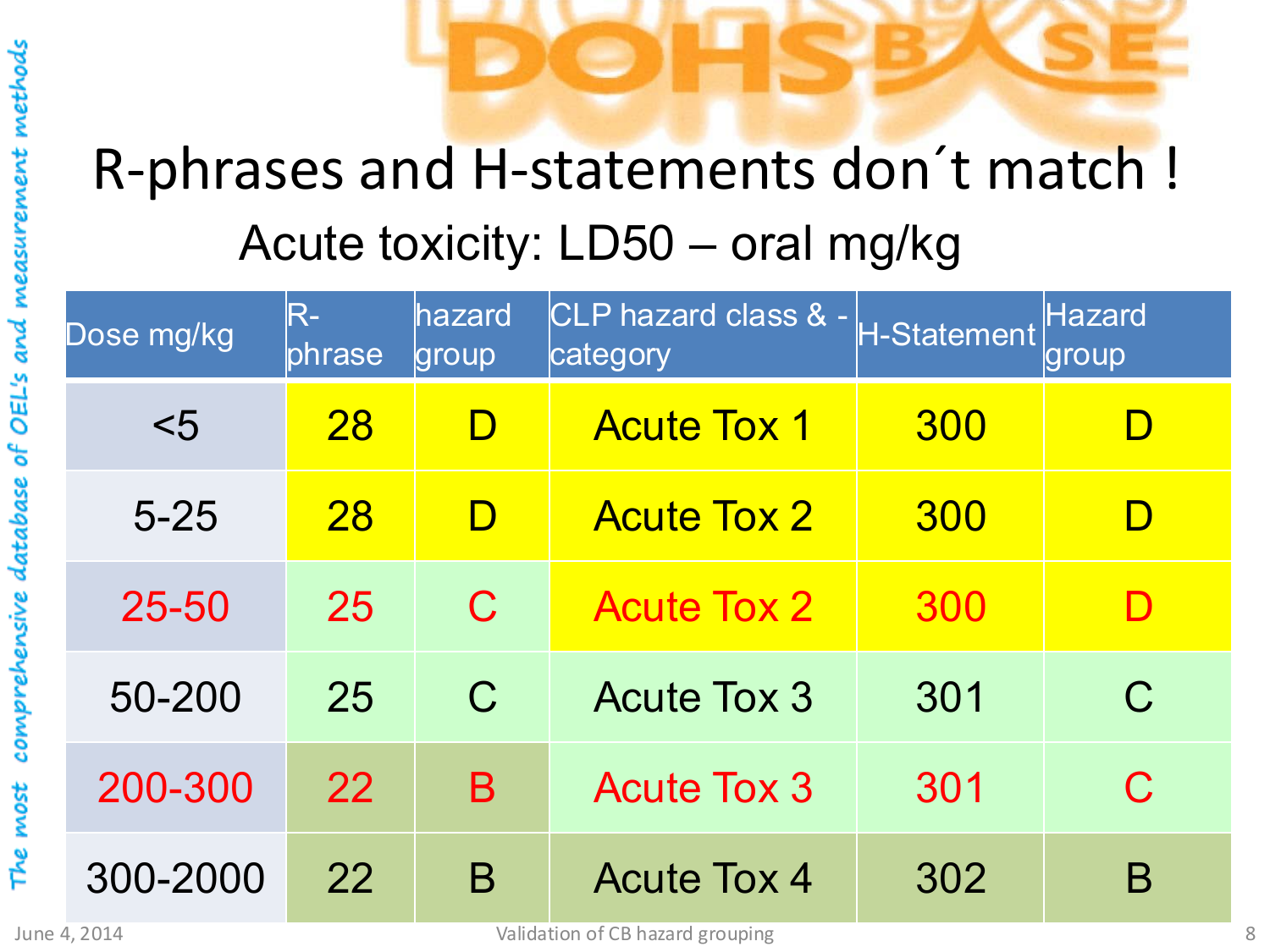
Source: Theo Scheffers, “Validation of CB hazard grouping”, presentation 4 June 2014.
Statistical Methodology: The 10th Percentile Tolerance Lower Bound
The choice of the 10th percentile as the basis for kick-off values is deliberate. Setting the benchmark at a point where 90% of existing OELs in the same hazard category are higher ensures that the kick-off value is conservative – it errs on the side of protection.
The tolerance lower bound approach adds an additional layer of conservatism. Rather than simply taking the raw 10th percentile of the observed data, the tolerance lower bound accounts for the uncertainty inherent in limited sample sizes. When a hazard category contains only a small number of substances with known OELs, the raw 10th percentile may not be a reliable estimate. The tolerance lower bound adjusts downward to account for this uncertainty, ensuring that the kick-off value remains protective even when the underlying data is sparse.
In practice, this means that kick-off values are most conservative (lowest) for hazard categories with the most severe H-statements and for categories with relatively few known OELs. As more OELs become available over time and the database grows, the statistical basis for kick-off values becomes more robust.
The chart below shows the cumulative distribution of OELs per COSHH H-hazard class from the 2014 validation study. The typical S-curve per hazard class is clearly visible, with a chaotic tail at the lower end that demonstrates why the 10th percentile is used as the statistically robust lower bound — rather than, for instance, the raw minimum, which would be disproportionately influenced by outliers:
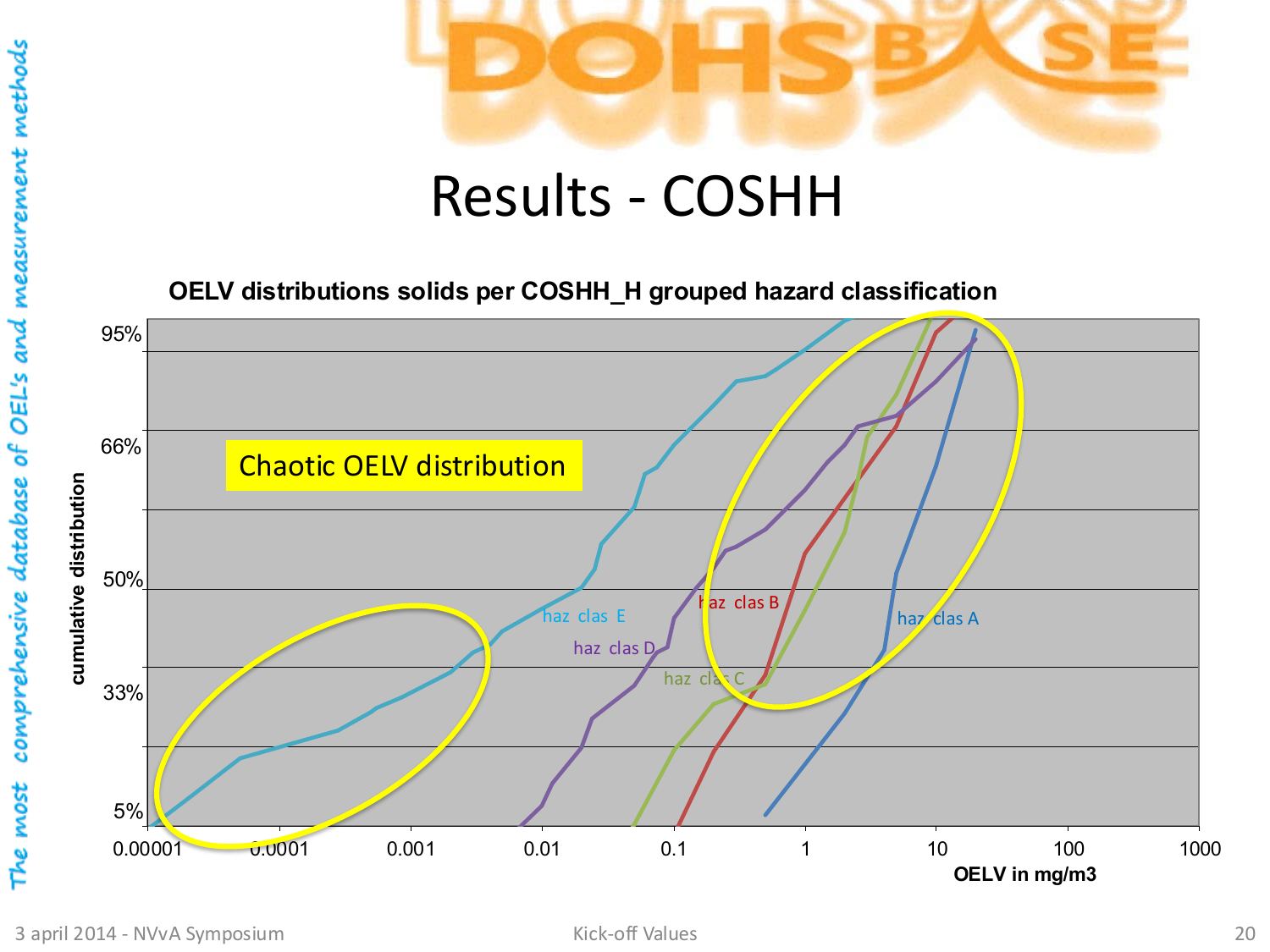
Source: Geert Wieling, “Kick-Off Limit Values for substances with limited human health-hazard information”, NVvA Symposium 3 April 2014.
The methodology was validated against multiple Control Banding systems — alongside COSHH, both EMKG and the German IFA/TRGS600 model were investigated. The box plots below show OEL TWA distributions per EMKG hazard class, where the rise from class E (lowest hazard) to class A (highest hazard) is statistically consistent with the COSHH results:
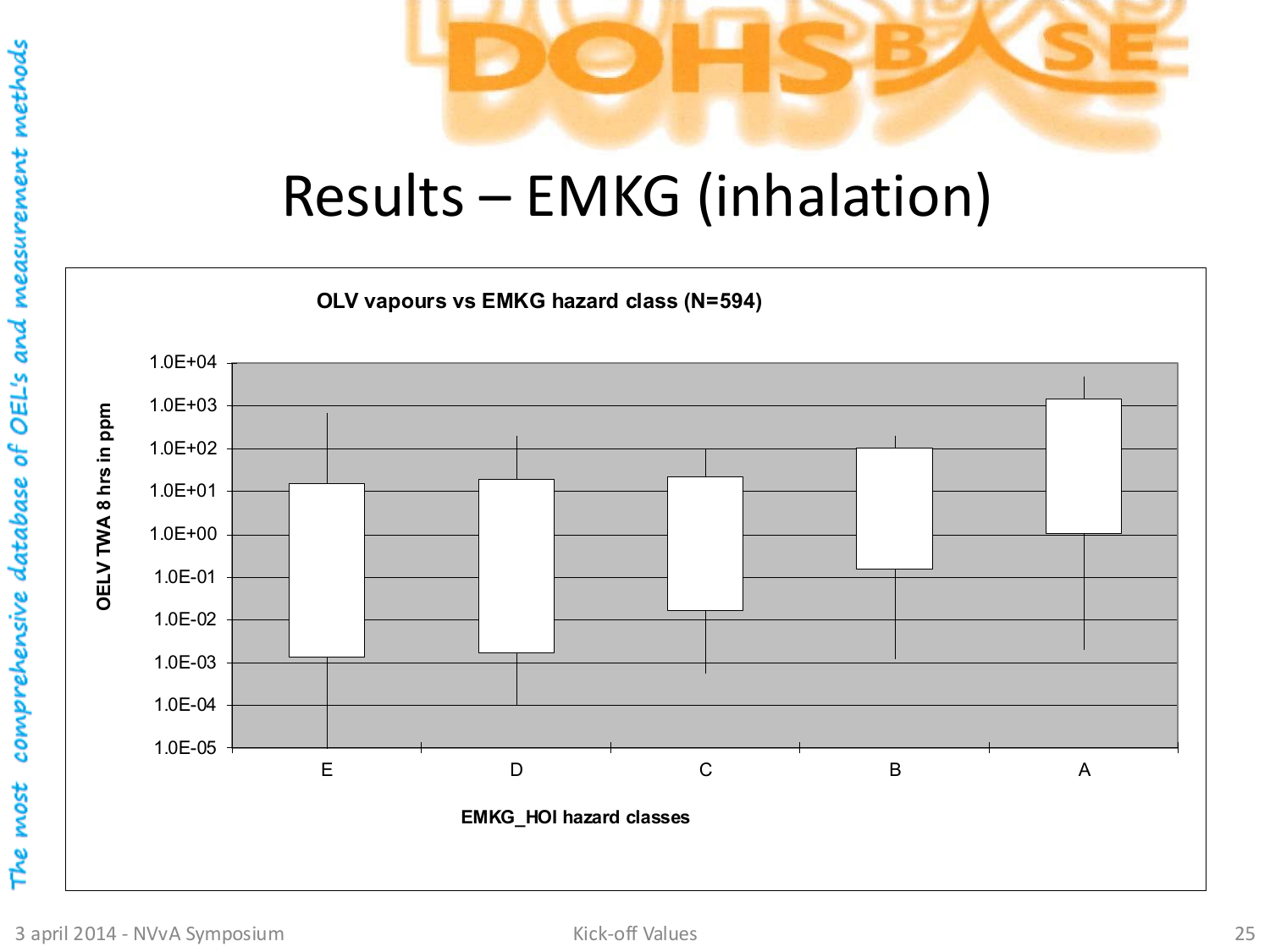
Source: Geert Wieling, NVvA Symposium 2014.
The Proposed Kick-Off Values from the 2014 Recalculation
The 2014 recalculation produced a set of proposed kick-off values per hazard group, published on the basis of the DGUV IFA Spaltenmodell (TRGS600). The table below shows the mapping between H-statements, hazard groups, and the proposed values for both gases/vapors (in ppm) and dust/aerosol (in mg/m³):
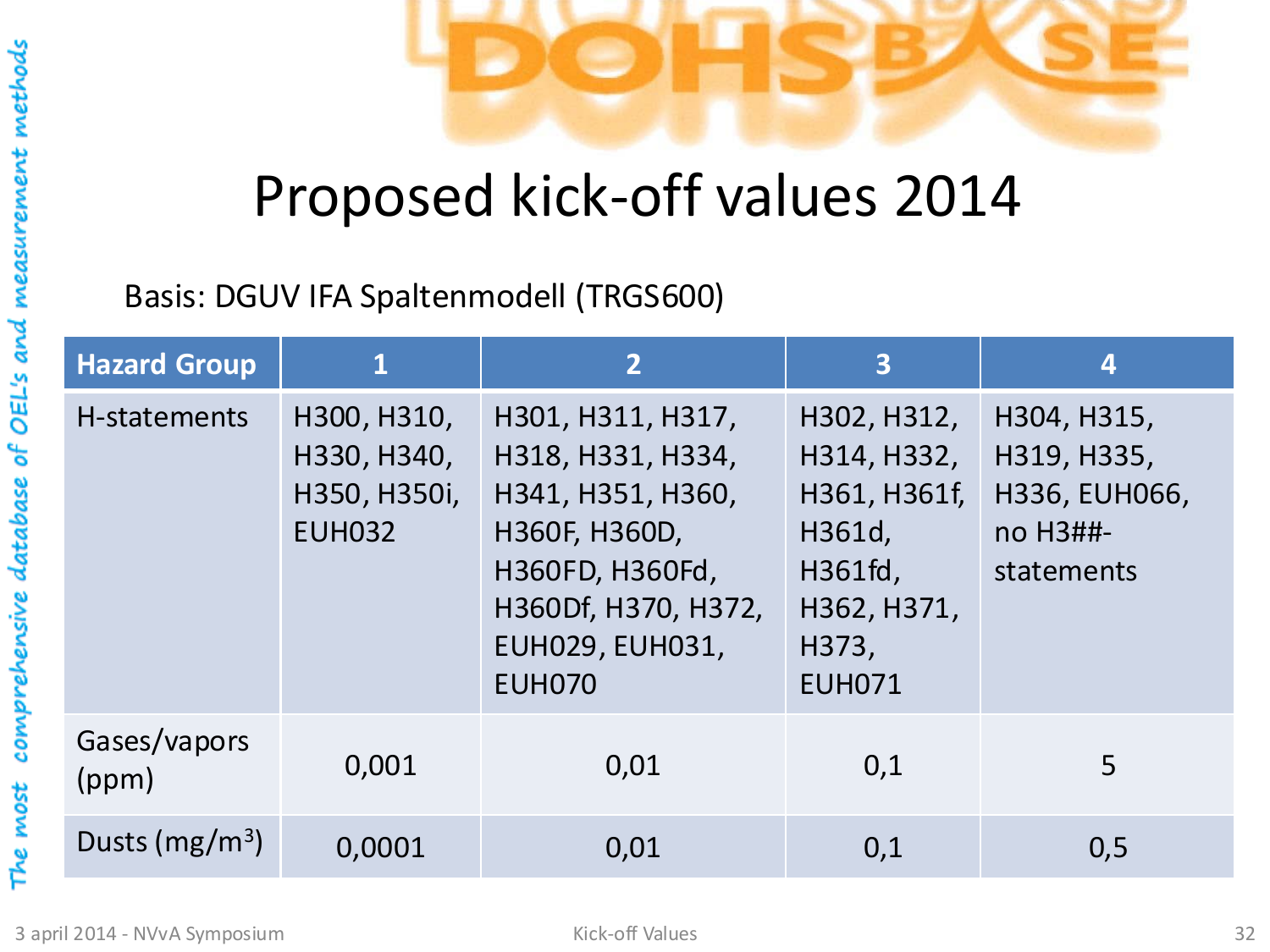
Source: Geert Wieling, “Proposed kick-off values 2014”, NVvA Symposium 3 April 2014. See also the 2014 revision document.
These values form the foundation of the more than 100,000 kick-off values in DOHSBase Online: for each substance, the most severe H-statement in the hazard classification is used to determine the corresponding hazard group, and the appropriate kick-off value for both the gas/vapor and the dust/aerosol fraction can be read directly.
Comparison with Other Approaches
Kick-off values are not the only method for estimating safe exposure levels in the absence of formal OELs. It is useful to understand how they relate to alternative approaches:
Derived No-Effect Levels (DNELs)
DNELs are calculated under the REACH regulation and represent the level of exposure above which humans should not be exposed. DNELs are substance-specific and based on the toxicological data submitted in REACH registration dossiers. While DNELs are more substance-specific than kick-off values, they are only available for substances that have been registered under REACH, and their quality depends heavily on the completeness of the registration dossier. DOHSBase includes over 5,300 REACH DNELs and ranks them within the limit value hierarchy alongside formal occupational exposure limits and kick-off values.
Health-Based OELs
Health-based OELs derived by scientific committees (such as SCOEL/RAC at EU level or DECOS in the Netherlands) represent the gold standard for exposure limits. They are based on comprehensive evaluation of all available toxicological and epidemiological data. However, due to the time and resources required, health-based OELs exist for only a small fraction of substances in use. Kick-off values serve as an interim measure for the vast majority of substances that have not yet undergone this rigorous evaluation.
Occupational Exposure Bands (OEBs)
Some organizations, particularly in the pharmaceutical industry, use Occupational Exposure Bands as an internal tool for categorizing substances into broad exposure ranges. OEBs are similar in concept to kick-off values but are typically developed on a company-specific basis and may use different classification criteria. Kick-off values have the advantage of being derived from a large, publicly referenced database and recognized by regulatory authorities.
Practical Implications
The availability of over 100,000 kick-off values in DOHSBase Online means that occupational hygienists can now conduct quantitative risk assessments for virtually any classified substance, regardless of whether a formal OEL exists. This transforms the practice of occupational hygiene from one where many substances could only be managed qualitatively to one where consistent, quantitative benchmarks are available across the board.
Limitations and When Kick-Off Values Are Not the Right Choice
The kick-off values methodology was deliberately designed as a conservative safety net for substances without formal occupational exposure limits, not as a replacement for substance-specific health-based assessments. Correct application in practice requires understanding the inherent limitations.
Conservative by Design
Setting the benchmark at the 10th percentile means the kick-off value for some substances may be substantially lower than what a health-based OEL derivation would yield. This is a deliberate choice: in the absence of substance-specific data, we err on the side of protection. In cases where the technical or economic feasibility of the kick-off value is under pressure, and the effort is justified, it is wise to commission an individual toxicological assessment rather than accept the kick-off value as the final exposure benchmark.
Depends on the Quality of the Hazard Classification
The methodology groups substances by their most severe GHS/CLP H-statement. If the H-statement classification of a substance is incomplete, outdated, or contested, the derived kick-off value will be too. This is a consideration for substances with recent reclassifications (ATP adaptations) and for substances where the notified classifications in ECHA’s Classification and Labelling Inventory differ significantly between registrants.
Statistical Generalization Can Mask Substance-Specific Deviations
Some substances — particularly carcinogens with an idiosyncratic dose-response, sensitizers without a threshold, and substances with multiple independent health endpoints — behave differently from the statistical average of their hazard category. For these substances the kick-off value remains a reasonable starting point, but not a substitute for an individual assessment.
Application to Solid Substances, Powders, and Dusts
The kick-off values methodology was developed primarily from the distribution of inhalation OELs for gases, vapors, and aerosols/mists. For solid substances — powders, dusts, and granular materials — several considerations apply:
- Dust fraction matters. Inhalation OELs for solid substances typically distinguish between inhalable, thoracic, and respirable fractions. The statistical distribution from which a kick-off value is derived does not always make this distinction explicit. Apply a kick-off value to the inhalable mass concentration as a general starting point, and consult substance-specific guidance when a specific fraction (such as respirable crystalline silica) is the relevant endpoint.
- The methodology works for most health-related H-statements applicable to solids — H335 (respiratory irritation), H334 (respiratory sensitization), H372/H373 (organ toxicity from prolonged or repeated exposure), and the CMR categories — because these endpoints are independent of physical form.
- Some H-statements are not relevant for solids. H304 (aspiration hazard), for example, is a liquid-specific endpoint and a kick-off value based on the inhalation OEL distribution is not the correct benchmark for it.
- For ultra-fine nanomaterials additional toxicological considerations may apply that fall outside the scope of a statistically derived kick-off value. For this substance class, an individual assessment based on specific nanomaterials guidance is recommended.
In practice, a kick-off value for a solid substance with a health-related classification (H300 series) is a valid starting point for exposure assessment of the inhalable fraction, with the same caveats about conservatism and substance-specific deviations described above.
Not All National Regulators Accept the Methodology
The Dutch Labour Inspectorate (Inspectie SZW) has explicitly referenced DOHSBase’s methodology as an acceptable approach for substances without formal OELs since 2012. Other national authorities — both within and outside the EU — may hold different positions. When using kick-off values in a formal assessment outside the Netherlands, it is prudent to verify that the methodology is accepted within the local regulatory framework before relying on it.
When You Should Not Use a Kick-Off Value
- When a formal OEL exists for the substance. TWA (TGG-8u), STEL, ceiling values, and REACH DNELs always take precedence over kick-off values. The DOHSBase limit value hierarchy places kick-off values explicitly at level 5 of 6 to make this priority unambiguous.
- For high-stakes assessments where individual toxicological evaluation is justified. For substances with large workplace volumes, high exposure frequency, or substantial economic consequences for control measures, commissioning a health-based company-specific OEL is the correct route.
- For substances with atypical dose-response characteristics. Idiosyncratic carcinogens, sensitizers without a threshold, and substances whose hazard category does not adequately represent their actual risk profile require a substance-specific approach.
- In jurisdictions where the methodology is not explicitly accepted by the competent authority. Verify the status within the local regulatory framework first.
Knowing these limitations is not a criticism of the kick-off values methodology — it is essential for applying it correctly and responsibly. A kick-off value is a practical, scientifically grounded starting point for the vast majority of substances that lack a formal limit, and it remains a valuable instrument within the DOHSBase limit value hierarchy — provided it is used within the application boundary described above.
Further Reading
- DOHSBase methodology: scientific validation and regulatory recognition — the external validation layer above this article: peer review, RIVM evaluation and Labour Inspectorate recognition
- The Science Behind Kick-Off Values: Our 2016 Peer-Reviewed Research — the full peer-reviewed study validating hazard banding
- EN 689 compliance assessment with UTL and Monte Carlo simulation — how DOHSBase Online statistically tests TWA measurements against OELs (including kick-off values)
- Kick-Off Values: Introduction and Methodology — Geert Wieling, NVvA presentation (March 2014)
- Proposed Kick-Off Values 2014 Revision — the 2014 revision proposal document
- Validation of Control Banding and Hazard Grouping — Theo Scheffers, conference presentation (April 2014)
- Kick-off grenswaarde on Dutch Wikipedia — independent description of the methodology