
On this page
Summary: Which air sampling method is suitable for measuring exposure to a substance depends on the limit value you assess against: a method’s measuring range and detection limit must reach well below that limit, as a rule of thumb around a tenth of it. DOHSBase Online therefore presents sampling methods in two ways. The Sampling methods tab lists every method for a substance in one place, regardless of which limit value it belongs to, which is the quickest way to see what is available. Opening a specific limit value shows the methods tied to that limit, which is more precise for a compliance assessment. Both routes show only personal air sampling methods drawn from publicly available standards, ordered by a fixed hierarchy.
Before you can assess exposure to a hazardous substance at the workplace, you need to know how to measure that exposure. A single substance often has several sampling and analytical methods, and not every method suits every situation. This article explains why method choice is tied to the limit value, and how to find the right method in DOHSBase Online, either through the tab listing all methods for a substance, or through a specific limit value.
The interface in the screenshots below is shown in Dutch.
Why the right method depends on the limit value
A sampling method is only usable for a compliance assessment if it can quantify concentrations well below the limit value. The reasoning from measurement strategy (the EN 482 family and exposure assessment under EN 689) is simple: to establish whether a measured concentration stays below the limit, the method has to measure reliably in exactly that region. A method whose detection limit sits at or above the limit value cannot rule out an exceedance.
As a rule of thumb, a method should quantify down to roughly a tenth of the limit value. It follows that a method’s suitability depends on the limit value you assess against. A substance often has several limit values, for instance a statutory and a private limit, an 8-hour TWA and a 15-minute STEL, or limits from different countries. A method suitable for one limit need not be suitable for another, lower limit. Other factors also matter: whether the method is suitable for personal air sampling (PAS), its validation level, the maximum sampling time and the sampling medium.
This is why DOHSBase Online presents sampling methods in two ways, each with its own purpose.
All sampling methods for a substance: the tab
The Sampling methods tab lists, in one place, every method available for a substance, regardless of which limit value it belongs to. This is the quickest way to see what exists for a substance. The same method is often used by several limit values; in this tab it is listed once, with a reference to every limit value it applies to.
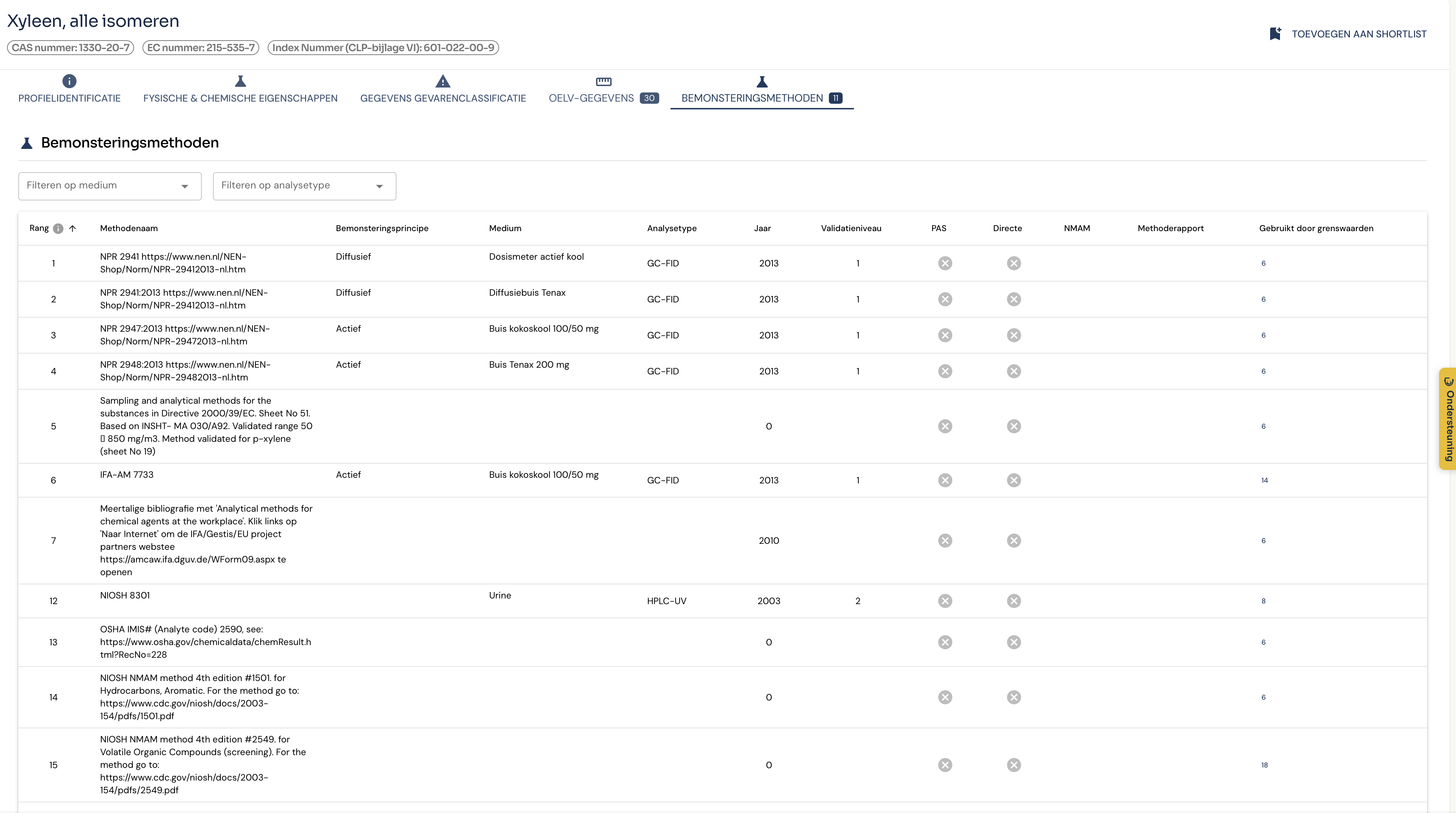
Each row is one distinct method. The main columns:
- Rank — the method’s original priority order from the source data; methods are sorted by rank by default. Because identical methods are merged into one row, the rank values can have gaps.
- Method Name — the name of the method, sometimes with a longer descriptive reference.
- Sampling Principle, Medium, Analysis Type — how the sample is taken and analysed (for example, active on coconut-shell charcoal with GC-FID).
- Year — year of publication.
- Validation Level — the method’s level of validation.
- PAS — whether the method is suitable for personal air sampling.
- Direct read — whether the method gives a direct reading.
- NMAM — the NIOSH NMAM method name, when available.
- Method report — a report or source reference, when available.
- Used by — how many limit values use this method. Click the count to jump to those limit values.
The scope is deliberately bounded: the tab shows only methods for measuring personal concentrations in the air at the workplace, drawn from publicly available standards. Wipe tests, indicator tubes, methods for emissions from materials and methods focused only on uptake through the skin are excluded. The order follows a fixed hierarchy: the rank from the source data, shown in the Rank column.
Above the table you can narrow the list with Filter by medium and Filter by analysis type.
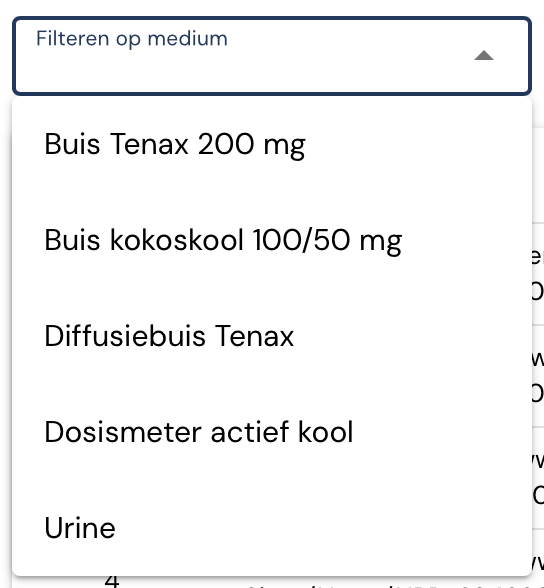
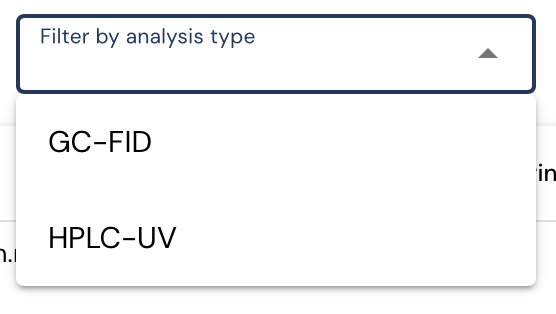
Click any row to open the method’s full details, including the concentration measuring range, the analytical detection limit, the sampling medium, the permitted flow ranges and the maximum sample volume.
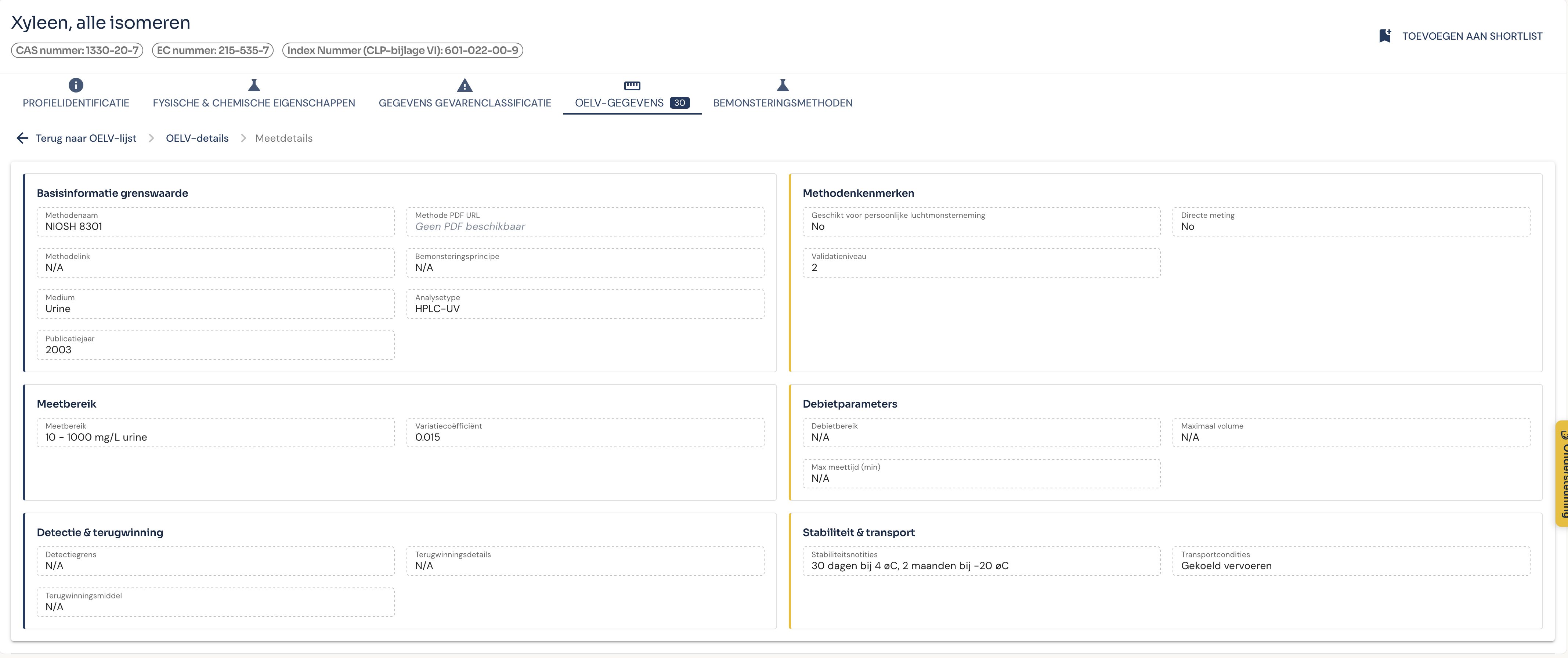
Methods per limit value: assessing more precisely
To see which methods belong to one specific limit value, go to the limit-value data tab (OELV), click a limit-value row to open its details, and read the Measurements table at the bottom listing the methods tied to that limit. This route is more precise when you assess an exposure against a concrete limit value, because it shows the methods suitable for that limit.
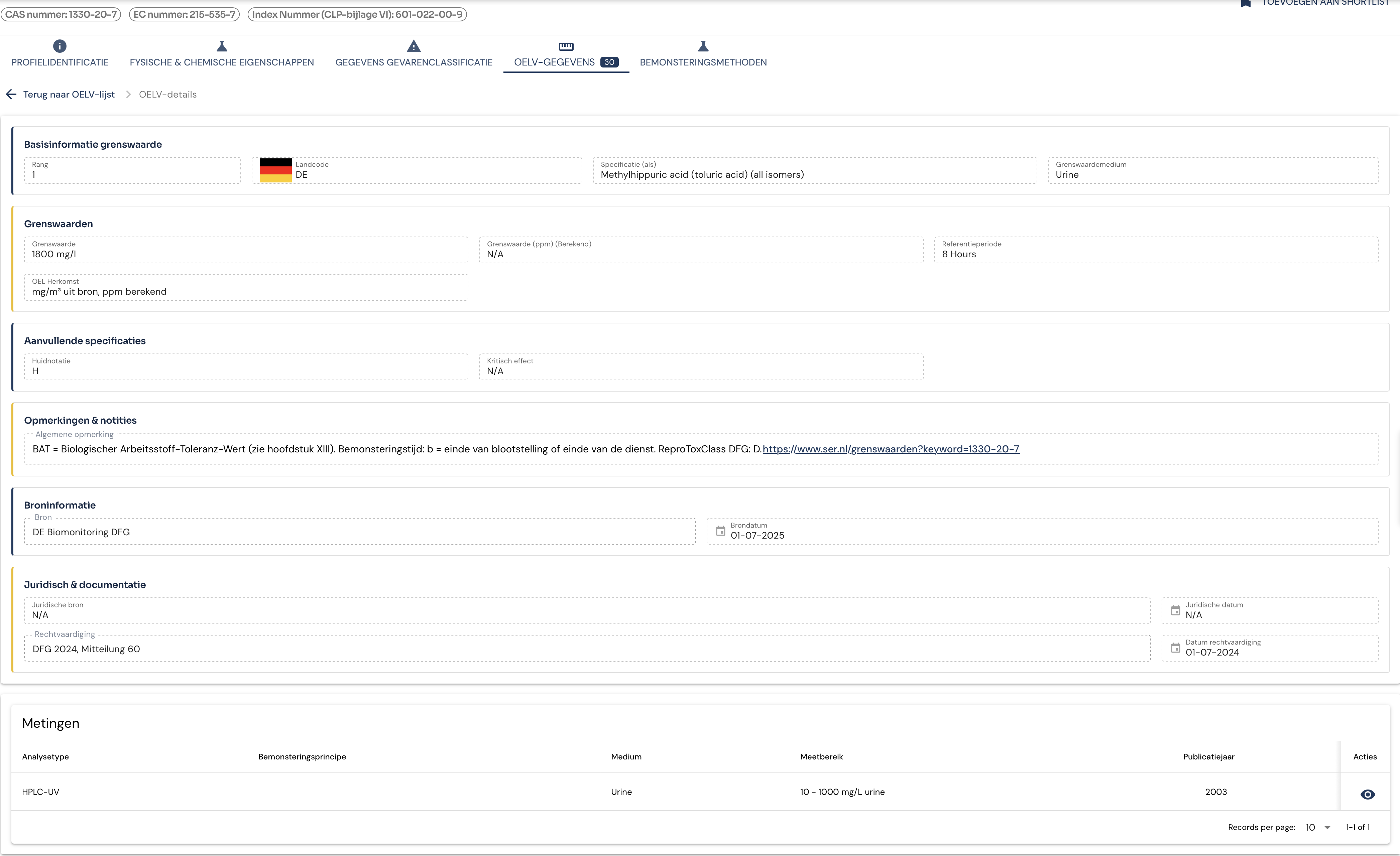
This was the only route after the functionality was expanded, and in practice it proved too restrictive: not everyone noticed that you first had to click a limit value, and anyone who simply wanted to know which methods exist for a substance missed the substance-wide overview. The Sampling methods tab has therefore been restored in full, alongside the per-limit-value route.
Which route do you use when?
- Quickly survey what is available — use the Sampling methods tab. One overview of all methods for the substance, filterable by medium and analysis type.
- Assess an exposure against a concrete limit value — go through the limit value. You then see the methods tied to that limit, including whether the measuring range reaches far enough below it.
In practice you use both: first the tab to see what exists, then the limit value to choose the right method for the assessment.
Step by step in DOHSBase Online
- Open the substance in DOHSBase Online. In the example above this is xylene (all isomers, CAS 1330-20-7), with 50 limit-value entries and 16 distinct sampling methods.
- For a substance-wide overview: open the Sampling methods tab. Filter by medium or analysis type if needed.
- Click a method for its full details (measuring range, detection limit, medium, flow ranges, validation level).
- To assess against a specific limit value: open the limit-value data, click the relevant limit, and review the methods tied to it.
- Check that the chosen method’s measuring range reaches well below the limit value before you use it.
Frequently asked questions
Why do the suitable methods differ per limit value? Because a method must measure reliably well below the limit value, as a rule of thumb down to about a tenth of it. At a lower limit, a method with a higher detection limit drops out.
Which methods appear in the Sampling methods tab? Only personal air sampling methods from publicly available standards. No wipe tests, indicator tubes, emission measurements or methods focused only on uptake through the skin.
Why are the rank numbers not always consecutive? Identical methods are merged into one row. This can create gaps in the rank numbers, and the highest rank shown can be larger than the number of rows.
What does “Used by” mean? The number of limit values that use this method. Click the count to jump to those limit values.