
DOHSBase Compare is back. What started in the early 2000s as the Vergelijk mode in the offline desktop version of DOHSBase2000 — a tool that let occupational hygienists rank a list of substances by health risk — has now been fully reimplemented in DOHSBase Online. The calculation core remains the TOX × TIX = RAS methodology of Wieling and Scheffers (NVvA Newsletter 2006-01); the web build brings that methodology into a shared, browser-based workflow for the first time.
A quick reminder of what Compare does
An occupational hygienist working with multiple substances at once regularly faces the question which substance deserves attention first? DOHSBase Compare answers that question by combining three elements per substance into a single Risk Assessment Score (RAS):
- TOX — a uniform class assignment (0–4) based on the H-statements
- TIX — a measure of how likely a substance’s vapour is to exceed its exposure limit (the ratio of saturation vapour concentration to OEL)
- RAS = TOX × TIX — the composite ranking index
The ranking is person-independent: the same input list yields the same ranking regardless of who runs the assessment. For the formulas and a worked example with phenol, methanol and toluene, see the knowledge-base article TOX, TIX and RAS score: the methodology behind DOHSBase Compare.
The web build in one screen
Up to thirty substances can be compared at once. The result comes back in two grids: a top grid with the ranked substances (ordered by descending RAS) and a bottom grid with substances that cannot be ranked because one of the three inputs is missing.
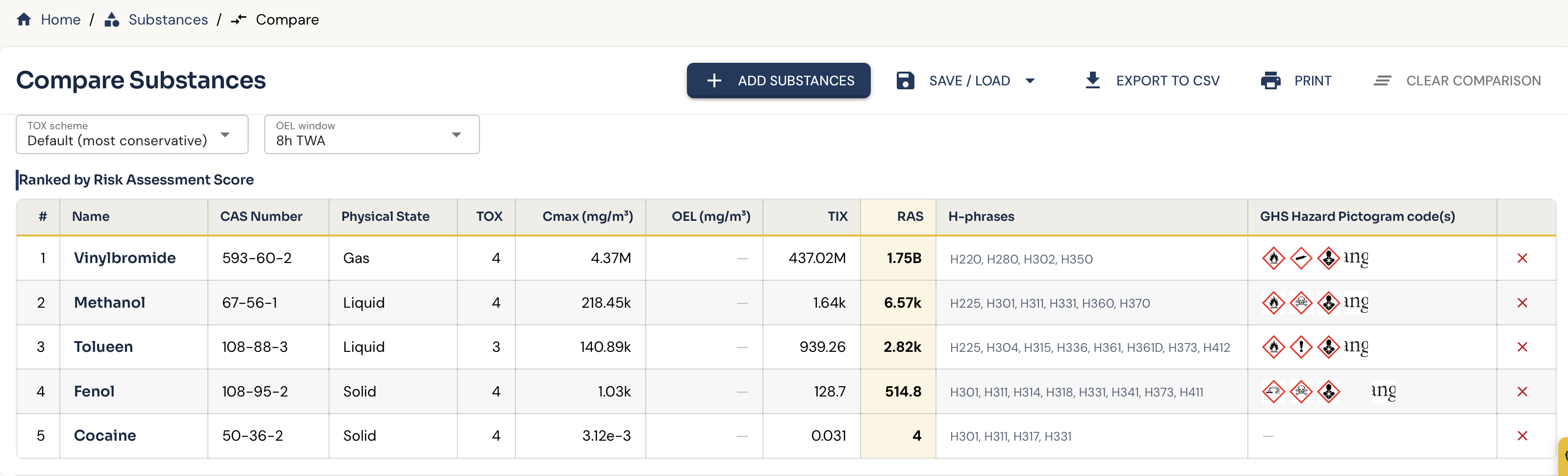
The top grid shows, per substance:
- Cmax — the calculated saturation vapour concentration
- OEL — the limit value used, with a yellow K badge when DOHSBase has applied a kick-off value (no regulatory or health-based OEL is available). Hover the badge to see which kick-off rule fired — COSHH, IFA, or both.
- TIX and RAS — the calculated indices
- H-phrases — the filtered H-phrase list (full list on hover)
- GHS pictograms — visual hazard signposting per substance
Two selectors above the grids
Two pulldowns above the grids drive the calculation. Both are URL-synced, so a configured ranking is directly shareable with a colleague.
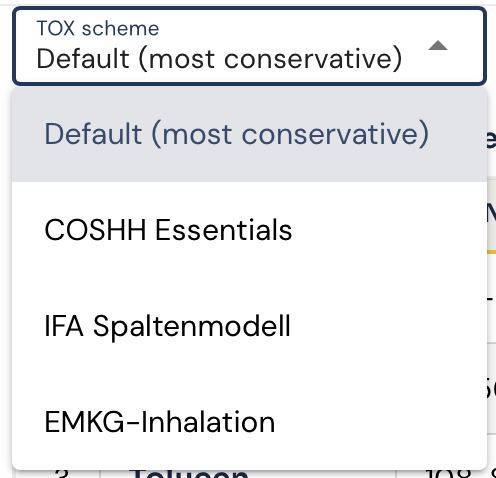
TOX scheme picks the hazard-banding system used to compute the TOX class:
- Default (most conservative) —
MAX(COSHH, IFA, EMKG)per substance. One ranking that never under-classifies. - COSHH — UK HSE classification, 5 classes (A–E)
- IFA — German DGUV-IFA Spaltenmodell per TRGS 600 (the successor to TRGS 440)
- EMKG — German Einfaches Maßnahmenkonzept Gefahrstoffe
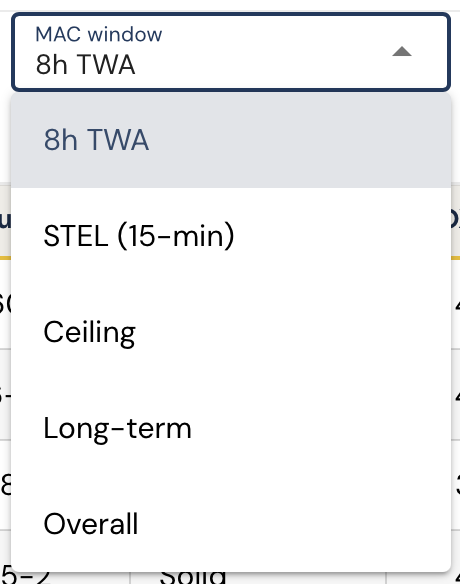
OEL window picks the limit value that serves as the denominator in the TIX calculation: 8h TWA (default), STEL 15-min, Ceiling, Long-term, or Overall. When a published STEL is missing the tool falls back to the Dutch SZW rule of thumb 2 × TWA.
Substances that cannot be ranked
Not every substance can receive a RAS. When one of the three inputs is missing — no TOX class in the selected scheme, no applicable OEL (not even a kick-off), or no vapour-pressure data to compute Cmax — the substance appears in the bottom grid with an explicit Reason column.
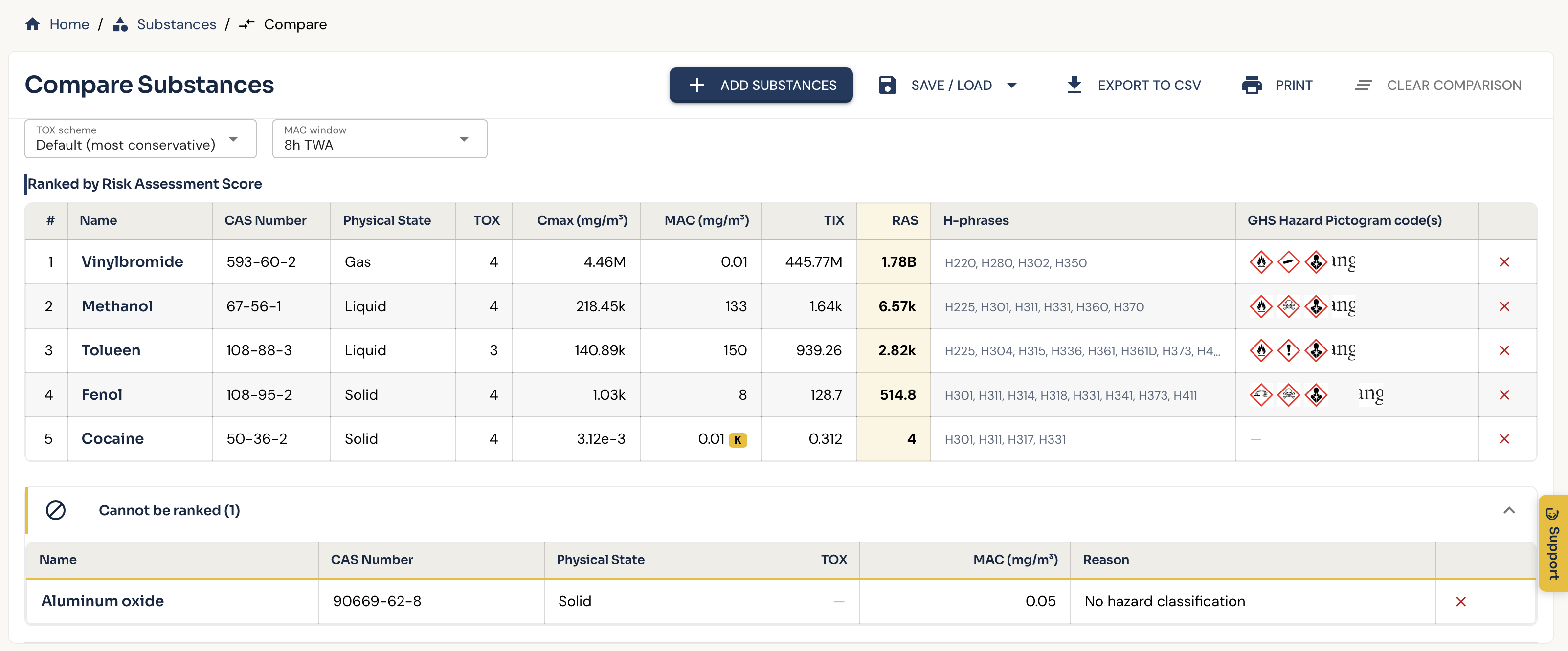
Surfacing this explicitly turns data gaps into an action list. Where the offline tool quietly dropped these substances from its output, the web build asks the hygienist to look at them: which substances need additional research before a defensible priority decision becomes possible?
Practical extras
- Bookmarkable URLs. The page URL carries both the selected substance IDs and the selector state (
?ids=1,2,3&tox=ifa&oel=stel). Sharing a ranking with a colleague is literally a URL copy-paste — same substances, same TOX scheme, same OEL window, same ranking. - Save & Load. Save a comparison under a custom name in the browser; load or delete previously saved lists. Storage is local to the browser and persists across sessions on the same device.
- Export to CSV. Both grids export into a single CSV with section headers, including the kick-off flag per row.
- Print. A dedicated print layout hides the UI buttons and fits the table to paper.
The methodology behind the scenes
For reproducibility the web implementation follows the offline version of DOHSBase Compare rather than the paper formula. Two deliberate divergences: TIX is shown as a raw Cmax / OEL ratio (without the logarithmic scaling from the paper), and RAS = TOX × max(TIX, 1) is unscaled. The ranking of substances is identical to the paper formula; only the absolute scores differ. See the implementation note in the methodology article for the full explanation.
Try it
Open the same comparison shown above — vinyl bromide, methanol, toluene, phenol and cocaine, ranked by descending RAS. The five substances span eight orders of magnitude in RAS: from 1.78 billion for vinyl bromide at the top to 4 for cocaine at the bottom.
No DOHSBase Online subscription yet? Request a free trial — your first comparison will be on screen within a minute.
Try DOHSBase Online
Look up 10 substances for free in our database of 325,000+ chemical substances.
Start Free Trial