
On the hazard classification tab we show a substance’s CMR classification: carcinogenic (C), mutagenic (M) and reprotoxic (R). This now reflects DOHSBase’s complete determination across every source, instead of leaning on a single list.
This page describes a change to the product. If you are looking for an explanation of what CMR substances are, how to recognise them and what obligations they carry, start with CMR substances in the knowledge base.
No single list is exhaustive — the harmonised EU classification (CLH) only covers substances that have been formally classified, and the SZW CMR list is explicitly non-exhaustive. So we combine them: as soon as any credible source classifies a substance, we include that category — how firmly it is classified is shown by the certainty level (see below). If, for example, IARC identifies a carcinogen that the SZW CMR list does not name, we still show it.
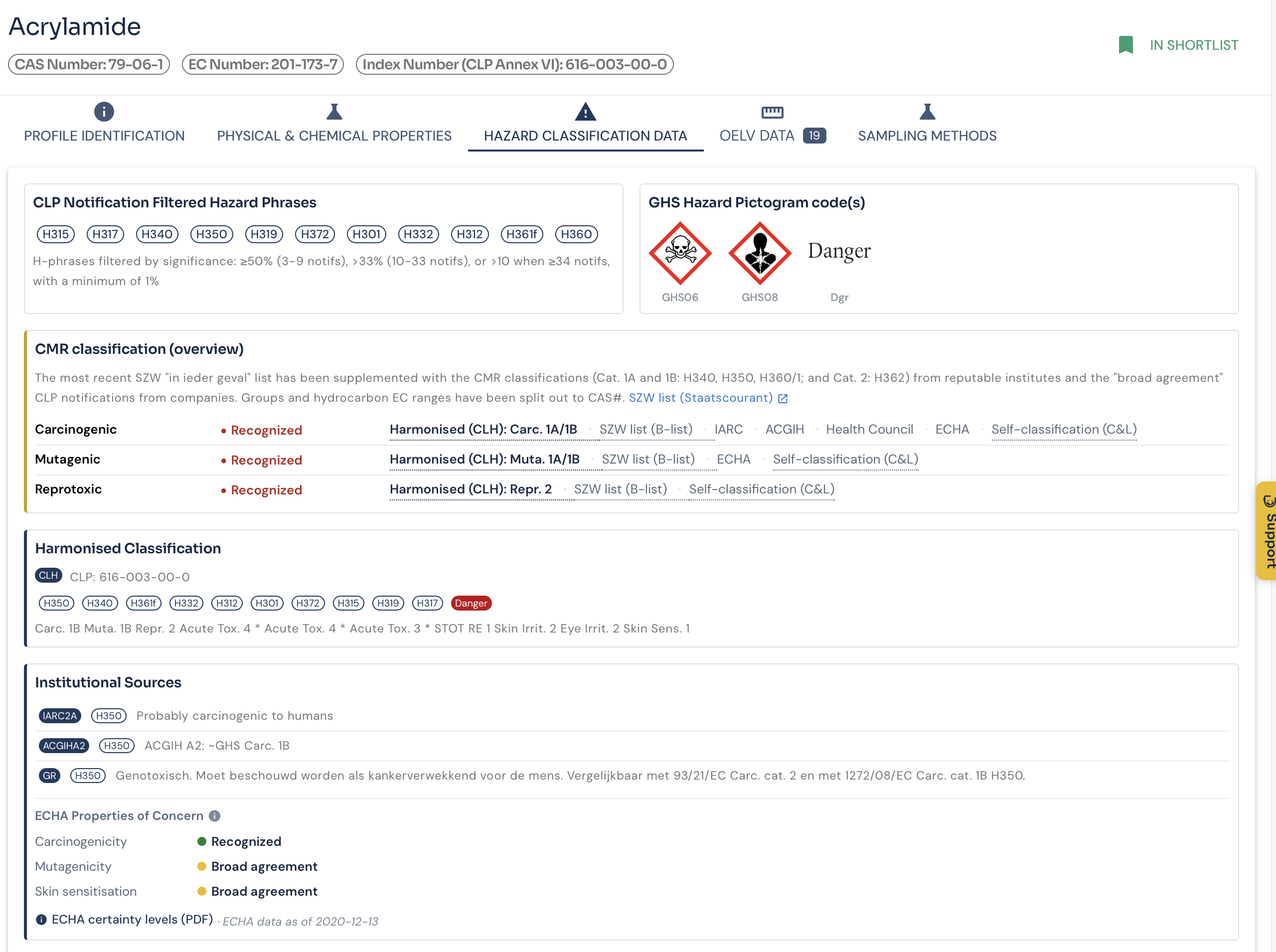
For each category you see the contributing sources, ordered by their authority:
- Harmonised (CLH) — the harmonised EU classification (CLP, Annex VI). This is the only legally binding classification, and is shown first.
- SZW CMR list — the Dutch CMR list of carcinogenic, mutagenic and reprotoxic substances, published by SZW in the Staatscourant; authoritative in the Netherlands. Where the substance is on the list we also show how it is listed (for example B-list). It indicates substances and processes covered by article 4.11 of the Dutch Working Conditions Decree, and is explicitly non-exhaustive — not to be confused with the SZW list (Annex XIII) of statutory limit values (see CMR substances).
- IARC, ACGIH, Health Council — international and national expert assessments.
- Self-classification (C&L) — classification and labelling notifications by manufacturers and importers; indicative.
Hover over any source for a short explanation of what it means and how much weight it carries.
The status shows the certainty level of the determination, following ECHA’s “Properties of concern” scheme — the strongest level across all sources, on a red scale (dark red → grey): Recognised (an official source — a harmonised classification (CLH) as Cat. 1A/1B, a regulatory list such as SVHC or the SZW CMR list, or a recognised expert rating like IARC 1/2A or ACGIH A1), Potential (suspected — a harmonised classification as Cat. 2, or IARC 2B / ACGIH A3), Broad agreement (industry CLP notifications with ≥ 50% of submitters aligned), and Minority position (5–50%). Where no source classifies a category it reads Not established. The full definitions are in the ECHA certainty-levels document (PDF).
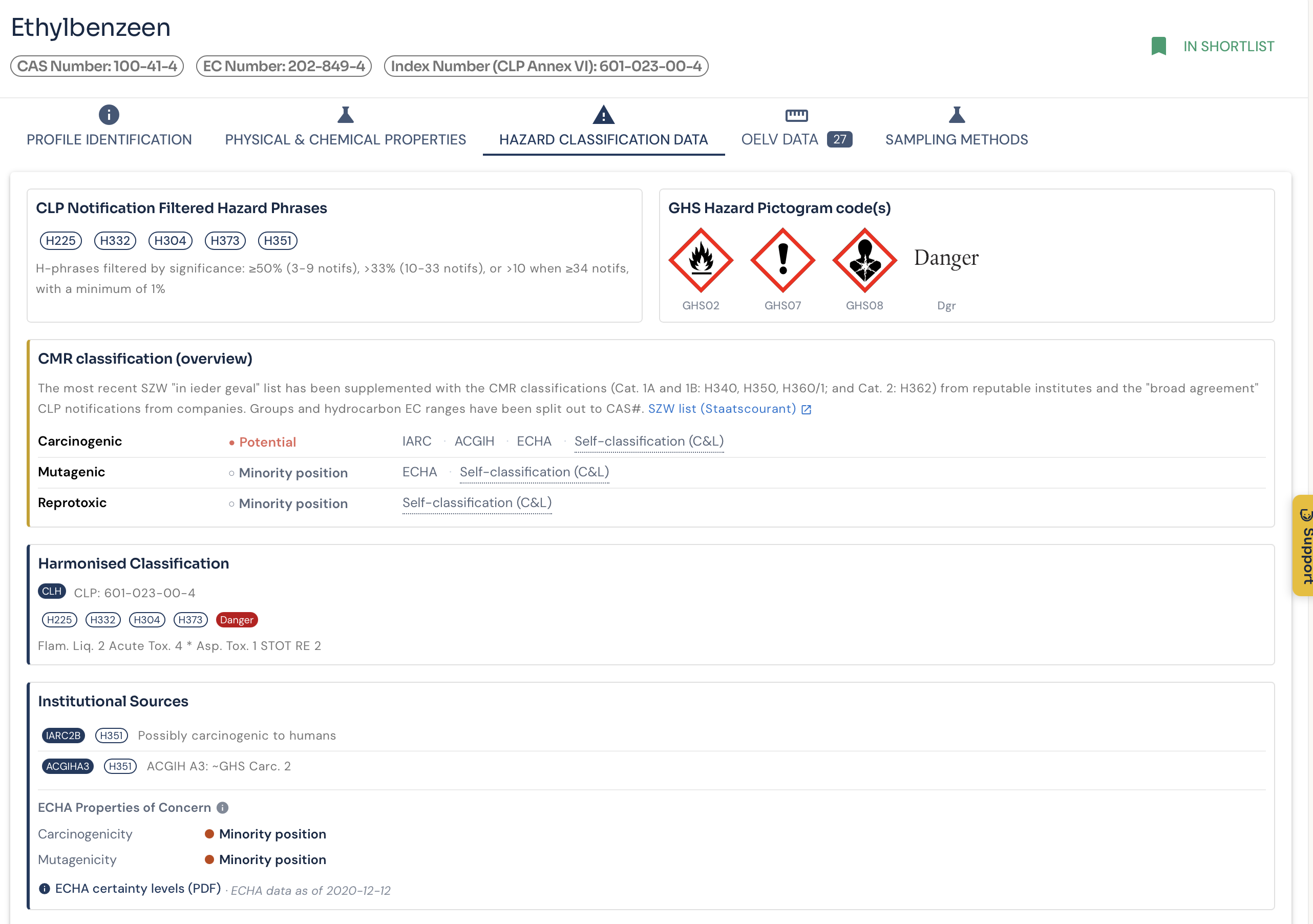
The classification adapts to the profile you work in. In the Dutch (SZW) profile the SZW CMR list is shown prominently, with its list entry. In other profiles — EU or FR, for example — the CMR classification follows that framework, and the Dutch CMR entry appears as a secondary reference rather than a headline.