
Determining a substance’s CMR status often takes more time than it should. The information is scattered across different lists and sources: the harmonised EU classification (CLH), the SZW CMR list, IARC, ACGIH, the Health Council and manufacturers’ self-classifications. None of them is complete on its own. To make that assessment easier, DOHSBase Online now brings these sources together in a single overview on the hazard classification tab. At a glance you see whether a substance is carcinogenic, mutagenic or reprotoxic, which sources say so, and how certain that classification is.
Why the assessment was fragmented
No single list covers every substance. The harmonised EU classification applies only to substances that have been formally classified. The SZW CMR list is explicitly non-exhaustive and adds substances partly through a Health Council opinion. IARC and ACGIH contribute international assessments, and the self-classifications from the C&L inventory vary from one another.
Until now, a complete CMR assessment therefore meant consulting several sources and laying the results side by side yourself. The legal duty to look beyond the harmonised list is set out in CMR substances and DOHSBase capabilities.
Every source on one screen
The hazard classification tab now shows, for each category (C, M, R), the contributing sources side by side, ordered by their authority: the harmonised classification first, then the SZW CMR list, followed by IARC, ACGIH and the Health Council, and finally the self-classifications.
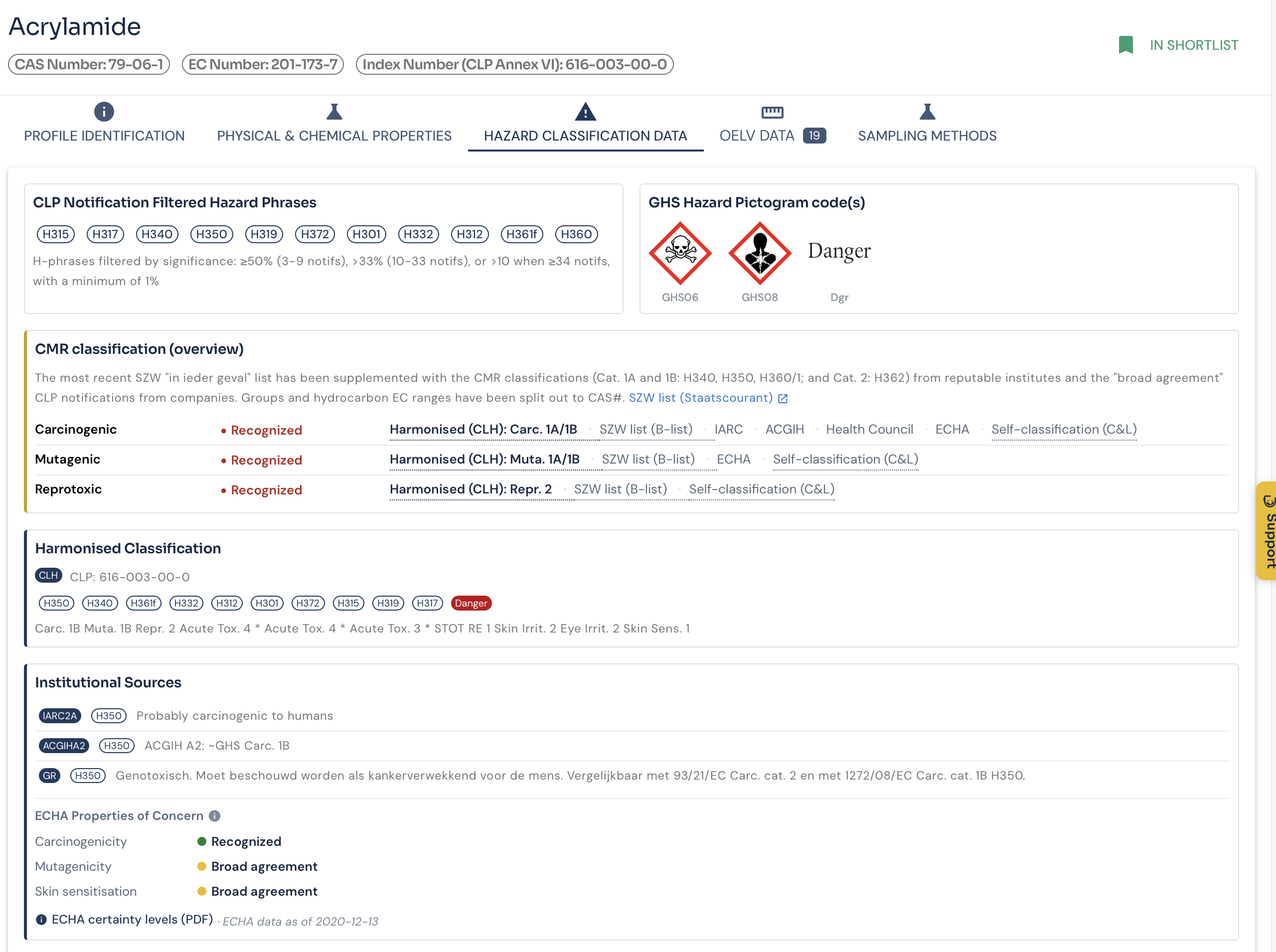
For acrylamide, above, all three categories rest on several sources at once. You no longer have to jump from tab to tab to assemble that picture: the full basis sits on a single row.
How certain is the classification?
Alongside the sources, each category shows a certainty level, following ECHA’s “Properties of concern” scheme. The colour tells the story: from Recognised (an official source, such as a harmonised classification or a recognised expert assessment) through Potential and Broad agreement to Minority position when the classification rests only on weaker signals.
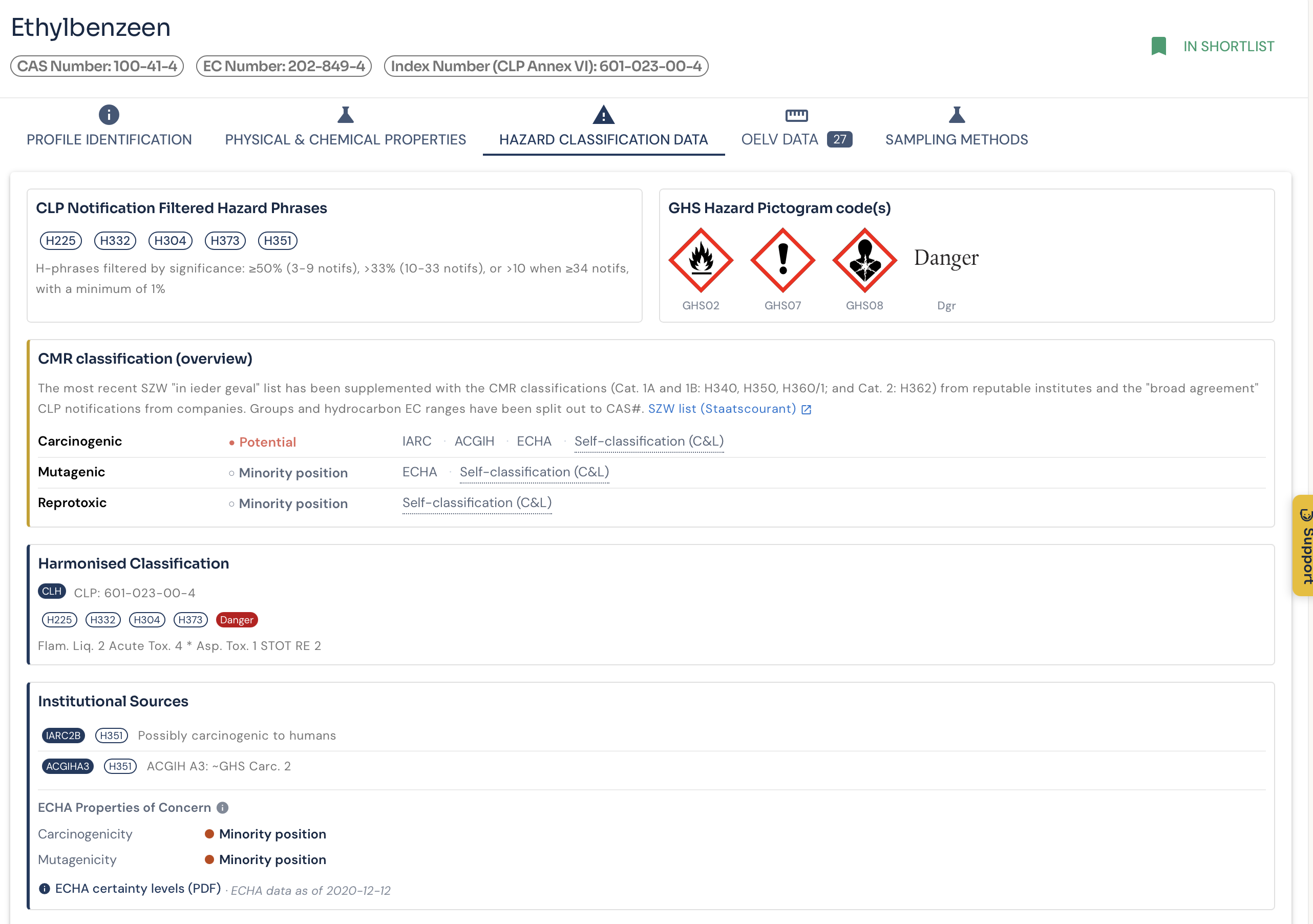
For ethylbenzene, above, the difference is immediate: carcinogenic appears as Potential, while mutagenic and reprotoxic rest on a minority position. You can tell a well-supported classification from one that warrants more caution at a glance, without weighing every source by hand first.
You make the assessment, we make the sources visible
This overview does not make the assessment for you. It is a starting point: it brings the sources together and makes their authority visible, so you reach the underlying material faster. The decision on which classification to adopt remains your own responsibility, exactly as the CLP Regulation (articles 4 and 5) requires: a substantiated, independent assessment based on all available information.
So our advice is to read the sources shown not as a final verdict but as an entry point. When in doubt, go back to the source, and use the certainty level to decide where closer examination matters most. The background to that duty is covered in CMR substances.
Try it yourself
Look up a substance in DOHSBase Online and open the hazard classification tab to see the CMR overview. Don’t have a subscription yet? Request a free trial and view your first substance within a minute.
Try DOHSBase Online
Look up 10 substances for free in our database of 325,000+ chemical substances.
Start Free Trial