
Following user feedback, the organic chromium compounds labelled “chromate” by ECHA have been removed from the CrVI category in DOHSBase. These compounds are trivalent (CrIII) and are not comparable to the much more dangerous hexavalent chromium (CrVI).
Context and scope
DOHSBase contains over 2,100 individual chromium compounds with valencies ranging from 1+ to 6+. Physical, chemical and toxicological properties differ markedly between and within the valency groups, and chemical stability varies greatly. With a single exception (butyl chromate), chromium compounds are solids that dissolve differently in water and other media.
Based on scientific sources and ECHA lists, DOHSBase now identifies 202 inorganic CrVI compounds that can occur in the workplace. Fifty of these are water-soluble CrVI compounds with a biological limit value based on urine monitoring.
The nomenclature problem
For the substance C.I. Acid Blue 158 (CAS 6370-08-7), ECHA uses IUPAC nomenclature while the US National Institutes of Health has chosen a more readable naming convention.
ECHA / IUPAC nomenclature:
Disodium hydroxy[3-hydroxy-4-[(1-hydroxy-8-sulpho-2-naphthyl)azo]naphthalene-1-sulphonato(4-)]chromate(2-)
NIH nomenclature:
disodium;chromium(3+);3-oxido-4-[(1-oxido-8-sulfonatonaphthalen-2-yl)diazenyl]naphthalene-1-sulfonate;hydroxide
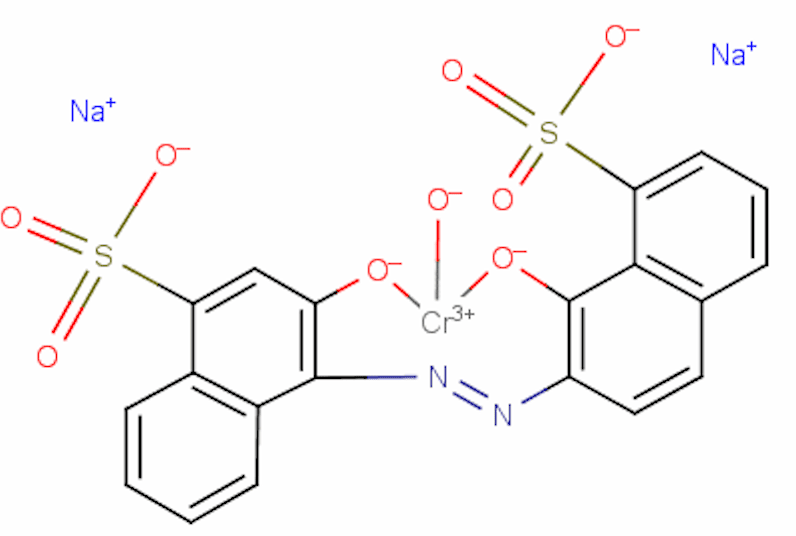
The word “chromate” in the ECHA name suggests the presence of hexavalent chromium — after all, under chemical nomenclature conventions the term chromate is reserved for CrVI compounds. In this example, however, the chromium is trivalent. The NIH name makes that explicit by writing “chromium(3+)”.
Why this matters: CrIII vs CrVI
CrIII and CrVI compounds differ significantly in toxicity because of differences in stability and water solubility. Some CrIII species are in fact essential in the human body (cytochrome c, for example). CrVI compounds are a different matter entirely: they are carcinogenic, reprotoxic and sensitising.
- CrIII — essential trace element, relatively harmless, stable
- CrVI — carcinogenic, reprotoxic, sensitising, oxidising
What this means for DOHSBase limit values
For organic compounds labelled as “chromate” by ECHA but actually containing CrIII, DOHSBase has adjusted:
- CrVI-specific limit values and measurement methods are no longer shown
- Hazard classifications are no longer based on the presence of CrVI
Compounds listed by ECHA as CrVI remain visible in the CrVI list for user verification, pending any future reclassification.
Practical consequences
This revised approach prevents:
- Incorrect application of CrVI-specific occupational hygiene limit values
- Incorrect assessment of workplace exposure risk
- Disproportionate precautionary measures
The adjustment improves the accuracy of chromium classifications in DOHSBase.
Originally published on LinkedIn, 25 September 2025.
Try DOHSBase Online
Look up 10 substances for free in our database of 325,000+ chemical substances.
Start Free Trial